
Franz Wright es el hijo de James Wright. Padre e hijo ganaron, en distintos momentos, el Premio Pulitzer de Poesía. Como decía el otro día, James Wright tuvo una vida muy dura. Su hijo Franz le heredó, además de su relación obsesiva son la poesía, la inclinación por el alcohol, las drogas, el suicidio. Wright padre abandonó a sus hijos cuando eran aún muy pequeños, pero Franz siempre mantuvo la comunicación con su padre. (En las cartas que he leído transluce mucha ternura). A los 15 años Franz le mandó una carta a su padre con el primer poema que había escrito. La respuesta de fue breve y contundente, muy suya: ''I'll be damned. You're a poet. Welcome to hell.'' Años después, el hijo le recordó esto a su padre en una carta y su padre le respondió: "Perhaps that was a kind of melodramatic thing to write to you. Certainly I was taking you seriously; and I still do, and will always. But now you know that I ought to have written something more precise. Perhaps I would have written more truly if I had bid you welcome to yourself, which as you well know contains hell all right but a good deal more than hell, too." En cualquier caso, Franz Wright vivió por un tiempo esa vida un poco infernal de su padre hasta que conoció a la mujer de su vida y ahí comenzó un camino que lo llevaría a la fe Católica. (Una vez escuché a alguien hablar de la santidad—en sentido estricto, no sólo de quien lleva sufrimientos con entereza—de su mujer). Fue una conversión muy sincera, que influiría tremendamente en su poesía, pero que no espantaría todos los demonios. Antes y después de la conversación Franz Wright sería conocido por su cierta locura. Su historia está lejos de ser la de un san Agustín. Sin embargo, cuando Wright habla de la fe, hay una de piedad de niño, de sentirse redimido hasta los huesos, con un agradecimiento de ponerse de rodillas, a pesar de la conciencia de sus muchas faltas, de sus desvaríos. Para más detalles sobre su conversión, esta conversación es sorprendente y fascinante. Genio y figura hasta la sepultura, Franz Wright no paraba de crear, de escribir poemas en pequeños papelitos. En su últimos dos años de su vida, cuando ya se estaba muriendo de cáncer, grabó 546 casetes, una mezcla de poesía, conversaciones, monólogos sin sentido. Hay un excelente programa de radio, cautivante y conmovedor, que narra cómo fue escucharlos todos.
El poema de hoy está sacado de Walking to Martha's Vineyard, el poemario que lo hizo merecedor del Pulitzer. Allí están los poemas de la época de su conversión. Él mismo cuenta, en la entrevista que enlacé arriba, que la mayoría de los poemas fueron escritos caminando hacia Misa, durante la Misa, o en el camino de vuelta.
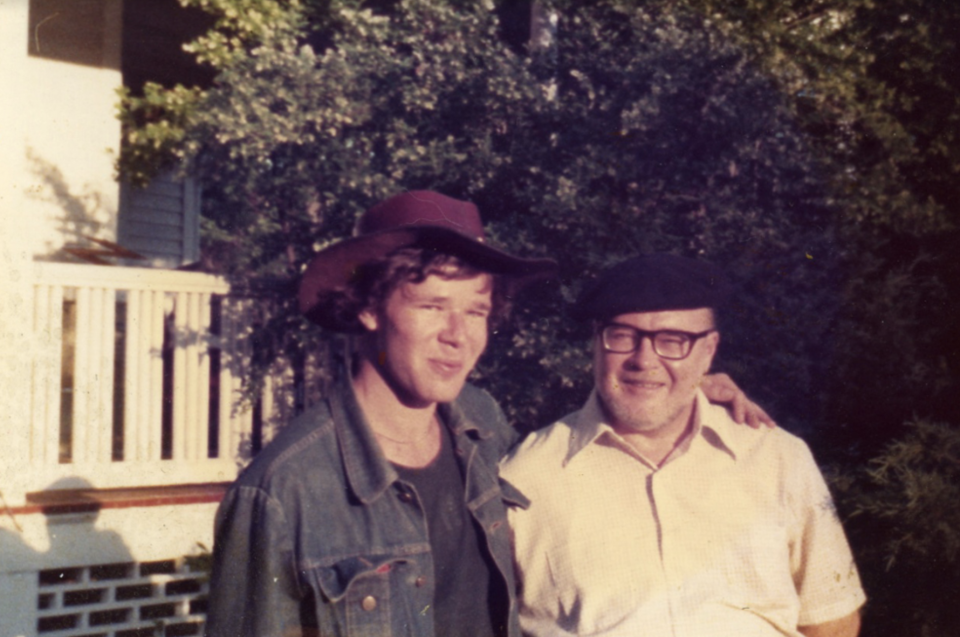 |
| (Franz y James Wright) |
LETTER
I am not acquainted with anyone
there, if they spoke to me
I would not know what to do.
But so far nobody has, I know
I certainly wouldn't.
I don't participate, I'm not allowed;
I just listen, and every morning
have a moment of such happiness, I breathe
and breathe until the terror returns. About the time
when they are supposed to greet one another
two people actually look into each other's eyes
and hold hands a moment, but
the church is so big and the few who are there
are seated far apart. So this presents no real problem.
I keep my eyes fixed on the great naked corpse, the vertical
corpse
who is said to be love
and who spoke the world
into being, before coming here
to be tortured and executed by it.
I don't know what I am doing there. I do
notice the more I lose touch
with what I previously saw as my life
the more real my spot in the dark winter pew becomes—
it is infinite. What we experience
as space, the sky
that is, the sun, the stars
is intimate and rather small by comparison.
When I step outside the ugliness is so shattering
it has become dear to me, like a retarded
child, precious to me.
If only I could tell someone.
The humiliation I go through
when I think of my past
can only be described as grace.
We are created by being destroyed.


